New Lisbon airport: VINCI Airports reaffirms its commitment to the development of the Portuguese economy
A key milestone has been reached for New Lisbon Airport: the engineering, cost and construction report has been submitted to the Ministry of Infrastructure and Housing on schedule.
Submission of the Environmental Impact Assessment before the end of July.
Continuation of an investment program dedicated to the modernisation of airport infrastructure in the Portuguese network.
ANA – Aeroportos de Portugal, a subsidiary of VINCI Airports, submitted the Engineering, Cost and Construction Report for the new Lisbon Luís de Camões airport to the Ministry of Infrastructure and Housing on July 16, 2026. This document consolidates the results of the preliminary design studies: functional program, operational capacity, multimodal connectivity, and long-term structural solutions.
By the end of the month, the final Environmental Impact Assessment will be submitted to the Portuguese Environment Agency (APA) and the Government, in accordance with the schedule stipulated in the concession agreement. Following the evaluation of these documents by the relevant authorities, the detailed design and architectural phase will begin.
With the submission of these two reports, ANA and VINCI Airports reaffirm their commitment to creating Portugal's new international gateway, offering a modern, competitive and sustainable airport solution that serves the country's economic development.
The ongoing and planned investment program by ANA and VINCI Airports is dedicated to modernizing airport infrastructure across the entire Portuguese network. This includes, in particular: in Lisbon, the new south pier and the renovation of the central pier, the south aircraft parking area of Terminal 2, and the border control area; in Porto, the complete rehabilitation of the runway, the airport operations control centre, and the modernization of the terminal; and expansion and modernisation work in Faro in the Azores and in Madeira.
The design of the new Lisbon airport continues this commitment and mobilises a multidisciplinary team of more than 250 engineers, specialists, technicians and environmental professionals.
Designed to become an international benchmark, Luís de Camões Airport will combine cutting-edge technology, operational innovation, and environmental sustainability. With a capacity to handle 56 million passengers per year upon opening, the airport will support the growth of air travel in Portugal for decades to come. Aiming to be among the most advanced airports in the world, it will include two runways, 120 aircraft stands, 194 self-service check-in kiosks, a passenger terminal of approximately 500,000 m², and innovative technological solutions to optimise operations and reinvent the passenger experience.
The airport will be integrated into a multimodal network including the third bridge over the Tagus, the high-speed rail network and new road connections, thus strengthening its territorial connectivity.
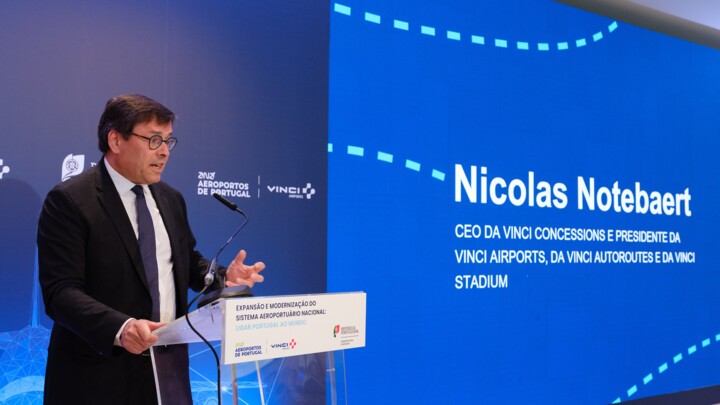
Nicolas Notebaert, Chief Executive Officer of Concessions at VINCI and President of VINCI Airports, declares:
“ With this significant new development, we are taking a key step in preparing for Lisbon's future airport while continuing to invest heavily in the country's current airport infrastructure.
VINCI Airports thus reaffirms its commitment to putting its expertise, know-how and investment capacity at the service of Portugal's ambitions, by developing modern, competitive and sustainable airport platforms, capable of meeting the growing demand for mobility, supporting economic development and accompanying the country's environmental transition.”
VINCI Airports, as the leading private airport operator in the world, manages the development and operation of more than 70 airports located in 14 countries. VINCI Airports draws on its expertise as a comprehensive integrator to develop, finance, build and operate airports, leveraging its investment capability and know-how to optimise operational performance and modernise infrastructure while bringing about their environmental transition. In 2016, VINCI Airports became the first airport operator to commit to an international environmental strategy, setting itself the aim of reaching zero net emissions (scope 1 and 2) across the network by 2050 while supporting its stakeholders’ transition.
For more information: